Custom seals are small components with demanding jobs. They must close gaps around doors, windows, hatches, and equipment compartments while resisting water, dust, vibration, and temperature changes. China’s vehicle industry offers a useful measure of the production environment: the China Association of Automobile Manufacturers reported 31.282 million vehicles produced in 2024. That figure covers the wider vehicle market, not special vehicles alone. Still, it highlights why clear specifications and repeatable quality checks matter at scale.
For buyers exploring How to customize sealing strips for special vehicles, the process starts with the application, not a material catalogue. Record the opening dimensions, compression space, installation method, exposure to weather, and expected service conditions. A door seal for a refrigerated vehicle may need different priorities from a dust-resistant seal for a utility truck. Specify the profile drawing, material, hardness, color, and test requirements before sampling. ISO 16750 provides environmental test guidance for road vehicle electrical and electronic equipment; it is not a seal-specific approval, so seal tests should match the actual use case. Ask suppliers for material data, sample measurements, and documented test results. Then fit the sample to the real body panel. A drawing is not enough. Small gaps can change compression, and production tolerances deserve attention. Customization is iterative, and the first sample may reveal an assumption worth revisiting.
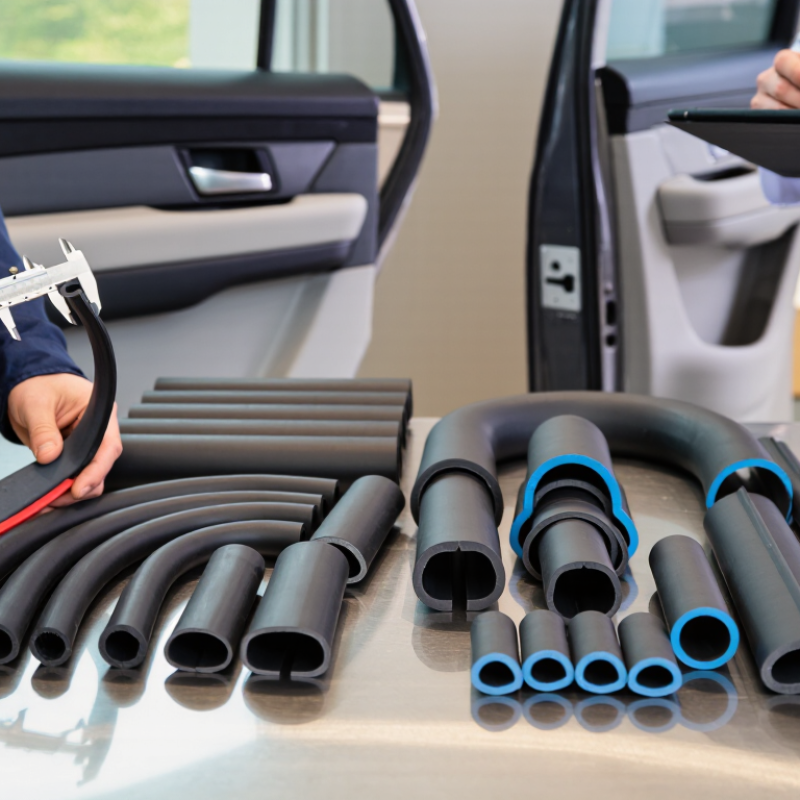
Before customizing special vehicle sealing strips in China, define where each strip will work and what it must protect. A door seal faces repeated closing pressure, while an engine-compartment seal may face heat, oil mist, and vibration. Record the operating temperature range, exposure to rain or dust, cleaning methods, and expected opening cycles. Measure the channel width, flange thickness, corner radii, and available compression space on the actual vehicle. Fit matters most. A profile that looks right on paper can buckle at a tight corner or leave a thin leak path.
Describe performance in measurable terms. Specify acceptable compression force, recovery after compression, dimensional tolerances, and resistance to aging or relevant fluids. For example, note whether a strip must remain flexible after cold storage or hold its shape near a warm engine bay. Provide drawings, photos, and a physical sample when possible; identify the vehicle location and installation direction on each. Early drawings are often wrong, especially around hinges and welded seams, so check the first sample on the vehicle before approving production. Small gaps leak. Keep records of test conditions and revisions, since “good fit” alone is difficult to verify across batches. Decide which failures matter most, too: water ingress, wind noise, dust entry, or excessive closing effort. These priorities guide material and profile choices without over-specifying the design.
Measure the channel at several points, including corners and joints. Record compression space, closing force, temperature exposure, and water paths. Show the cross-section, tolerances, splice location, and installation direction on the drawing.
Choose a compound for the actual conditions, not price alone. EPDM may suit outdoor exposure, while other compounds may handle oils, heat, or abrasion better. Assumptions need testing.
Fit it to an actual door or body fixture. Check whether corners lift, the strip rolls, or closing effort increases. Fit is unforgiving. Revise the profile or hardness, then test again.
Test the actual profile against its real flange. Check recovery, water ingress, closing force, heat ageing, ozone exposure, compression set, and dimensions after cycling. Record temperature, compression time, and water pressure.
One leak result may not tell the whole story. Repeat testing with a controlled fixture, since small changes can affect results. Adhesive joints may fail before the rubber does.
Confirm the vehicle category, installation location, and current requirements with the customer and testing laboratory. GB/T 30512-2014 addresses restricted substances in automobiles. GB 8410 concerns interior-material flammability where applicable.
Agree on checks for dimensions, surface defects, adhesion, and compression recovery. Request measurement records from pilot batches. Keep each sample linked to its drawing revision, compound, and tooling changes.
Protect strips from bending, dust, and prolonged heat during storage and transport. Confirm tooling approval, material availability, inspections, and shipping milestones in writing. Delays happen. Leave time for sample revisions.
Customizing sealing strips for special vehicles begins with a clear definition of operating conditions, including temperature changes, exposure to water or dust, vibration, installation space, and expected service life. These requirements guide the choice of material and seal profile, helping ensure a suitable balance of flexibility, durability, compression, and environmental resistance. The phrase “How to customize sealing strips for special vehicles” captures a process that turns vehicle-specific needs into a practical sealing solution.
After selecting an initial design, manufacturers can develop custom drawings, tooling, and prototypes for fit and function checks. Performance testing helps verify sealing effectiveness and durability, while applicable quality and regulatory requirements should be confirmed before production. In China, careful production planning, consistent quality control, clear communication, and coordinated delivery help keep the project on schedule and ensure the finished strips meet the agreed specifications.

 Haala Parts