Choosing an automotive sealing supplier in China requires more than comparing unit prices. How to compare different automotive sealing suppliers begins with the part’s real job: keeping water, dust, noise, or fluids out under defined operating conditions. A door seal and an engine gasket face different heat, pressure, and aging demands. Small differences matter.
Review the supplier’s material data, dimensional tolerances, tooling controls, and test records. Ask how compound batches are identified and how production changes are approved. Request evidence for relevant tests, such as compression set, aging, and leak performance. Check whether the supplier can explain a failed sample clearly, not just send a replacement. Site visits can help, but document reviews and independent testing may also reveal gaps.
W. Edwards Deming, a quality-management expert, wrote, “Quality comes not from inspection, but from improvement of the production process.” That idea is useful when comparing sealing suppliers: look at how defects are prevented, tracked, and corrected. A polished brochure can still leave basic questions unanswered. A tidy spreadsheet can, too. Compare lead times, production capacity, engineering support, traceability, and communication alongside price. Verify claims against records and sample performance. No single scorecard captures everything, and a supplier that looks strongest on paper may need closer technical review. The comparison should make trade-offs visible, not hide them.
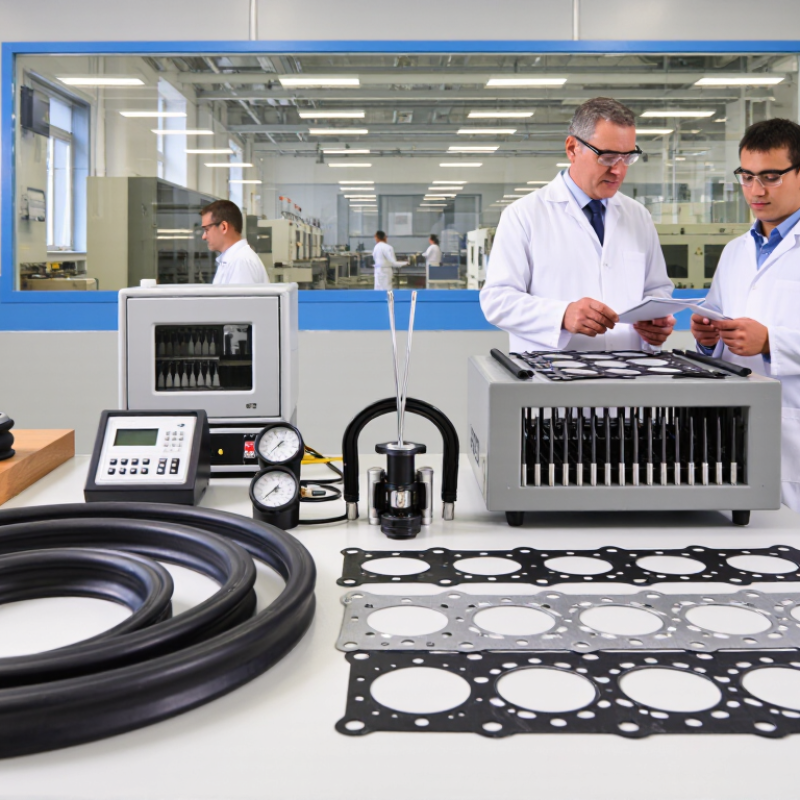
Before comparing automotive sealing suppliers in China, define the part’s job and operating environment. Is it a door seal, battery enclosure gasket, or fluid-system seal? Each faces different pressures, movement, and exposure. Record the mating surfaces, installation space, expected service life, and contact with water, oil, coolant, or dust. Be specific. A temperature range is more useful than saying “high heat,” but confirm it against actual vehicle conditions.
Set measurable requirements for material, hardness, compression, recovery, dimensional tolerance, and surface finish. For example, note the permitted gap after compression and the locations where leakage is unacceptable. Include drawings, sample parts, and test conditions where available. A supplier cannot judge fit from a material name alone. Lab targets can also distract from installation reality; a seal may pass a test yet wrinkle during assembly.
Define supplier scope before requesting quotations. Will the supplier make the profile or molded part, develop tooling, perform cutting and joining, and inspect finished components? Clarify who provides material data, prototype samples, validation reports, and production traceability. Ask what testing is done in-house and what is subcontracted. Keep the first requirement sheet practical, then revise it after prototype fitting. Some details will be missed. That is a reason to document assumptions, not to hide them.
Use this framework to define an RFQ scope and compare supplier responses. The values and examples below are planning references, not universal specifications; vehicle drawings, material specifications, and customer requirements take precedence.
| Requirement Area | Define Before the RFQ | Supplier Scope to Confirm | Evidence and Comparison Criteria |
|---|---|---|---|
| Application and part list | Identify each sealing location, such as door weatherstrips, glass run channels, trunk seals, underhood seals, or body grommets. Provide part numbers, quantities, vehicle program, and annual-volume assumptions. | Confirm which parts and manufacturing steps are included in the quotation, including prototypes, production parts, service parts, and any customer-supplied components. | Compare the quoted part list against the RFQ line by line. Check that tooling, packaging, testing, and logistics are clearly included or excluded. |
| Function and environment | Define the required functions: water and dust exclusion, wind-noise reduction, glass guidance, vibration isolation, or protection from heat and fluids. State the relevant vehicle zones and environmental exposures. | Confirm the supplier’s design and validation responsibility, including recommendations for material or profile changes and responsibility for meeting stated performance requirements. | Request a requirement-to-test matrix. Compare proposed tests, sample quantities, test conditions, acceptance limits, and responsibility for any failed-test investigation. |
| Material and hardness | Specify the approved material family and any drawing-defined grade, color, hardness, density, or surface requirements. EPDM is commonly used for exterior weather seals; silicone or other materials may be selected for particular temperature or chemical needs. | Clarify whether the supplier compounds material in-house or purchases it, and whether material formulation, color, or source changes require customer approval. | Review material data sheets, certificates of analysis, incoming inspection plans, and change-control procedures. Ensure quoted properties match the project specification rather than relying on a generic material description. |
| Profile and dimensions | Provide 2D drawings, 3D data, cross-sections, tolerances, critical dimensions, interface details, and the applicable revision level. Identify attachment features, lips, cavities, and mating surfaces. | Define responsibility for profile design, die development, dimensional optimization, and coordination of engineering changes. Confirm capability for the required profile size and geometry. | Request dimensional inspection reports from initial samples and confirm the measurement method for flexible profiles. Compare critical dimensions, drawing revision, and sample approval status. |
| Manufacturing processes | Identify required processes, such as extrusion, co-extrusion, flocking, coating, cutting, splicing, corner molding, adhesive application, or carrier integration. | Map each operation to the supplier’s own facility or an approved subcontractor. Confirm process ownership, subcontractor controls, production location, and contingency arrangements. | Review the process flow, equipment list, process controls, and samples from relevant operations. Compare the proposed manufacturing route with the part construction and quality requirements. |
| Fit, installation, and retention | Define interfaces with the body, glass, trim, and closure systems. Specify installation method, retention features, insertion or pull-off requirements where applicable, and any assembly constraints. | Confirm support for prototype builds, installation trials, fit checks, and root-cause analysis for assembly issues. Clarify who supplies fixtures or mating components. | Compare installation-trial results, fit-check records, and any required force or retention test data. Ensure testing uses representative mating parts and agreed procedures. |
| Durability and validation | Define applicable aging, ozone, weathering, compression-set, tensile, water-ingress, and functional tests based on the material and part application. Specify test duration, conditions, and acceptance limits. | Confirm in-house laboratory capability, accredited external laboratory access where needed, sample preparation, test scheduling, and responsibility for validation reports. | Request test plans and reports using agreed methods. Relevant ISO methods may include ISO 188 for accelerated aging, ISO 1431-1 for ozone resistance, ISO 815-1 for compression set, and ISO 37 for tensile stress-strain properties; confirm the applicable edition and project conditions. |
| Quality systems and launch | State required quality-management approvals, customer-specific requirements, launch milestones, and deliverables such as APQP records, process FMEA, control plans, and production-part approval documentation. | Clarify the supplier’s quality-system status, program-management resources, engineering support, change notification process, and ability to support audits and corrective actions. | Verify current certificates directly and review relevant audit or launch evidence. Compare the completeness and timing of APQP, FMEA, control-plan, and PPAP deliverables; certification alone does not establish part-specific capability. |
| Capacity and continuity | Provide annual demand, peak demand, ramp-up schedule, expected program life, delivery locations, and any required buffer or continuity plan. | Confirm available capacity by process and site, tooling ownership and maintenance, lead times, second-source arrangements, and recovery plans for production interruption. | Compare capacity calculations with the stated production route and demand profile. Request a documented capacity plan, tooling-maintenance plan, and business-continuity approach. |
| Commercial and logistics scope | Define delivery terms, destination, packaging and labeling requirements, forecast assumptions, payment terms, quotation validity, and the expected treatment of tooling and engineering costs. | Separate recurring part cost from non-recurring engineering, tooling, testing, packaging, freight, and other charges. Confirm packaging design, returnable-container options, and shipment responsibility. | Compare quotations on the same volume, delivery, packaging, and tooling assumptions. Record exclusions, currency, lead times, price-adjustment terms, and quote validity before ranking offers. |
Ask who performs compounding, extrusion, molding, cutting, and assembly. Request a process map and production location for each step. A catalog alone does not prove factory ownership.
Check extrusion consistency, corner joining, and dimensional inspection. Request samples from normal production. Corners deserve attention.
Ask for compound specifications, hardness ranges, aging data, and batch traceability. EPDM often suits weather-exposed seals; silicone may stay flexible across wider temperatures. Names alone prove little.
Review incoming-material checks, mixing records, cure settings, and inspection plans. Compare batch paperwork with sample records. A certificate is not enough.
Consider compression set after heat aging, low-temperature flexibility, leakage, and relevant chemical or ozone resistance. Agree on test methods, sample sizes, and limits before comparing results. Small details matter.
Use a controlled drawing and suitable gauges to measure critical dimensions. Check flash, splice joints, surface finish, corners, and fit on representative body panels. Keep a retained sample.
No. Review ordinary production records and, if possible, observe a normal shift. Ask operators how they detect dimensional drift. A prepared tour can hide gaps.
Repeat testing and review evidence behind any corrective action. Agree on trial quantities and acceptance limits before scaling up. Even a clean result can mislead.
How to compare different automotive sealing suppliers starts with clearly defining the vehicle application, operating conditions, required sealing functions, and expected production volumes. With these requirements established, buyers can identify suitable supplier types and assess manufacturing capabilities, such as tooling, molding, extrusion, material processing, and capacity for consistent production. A careful comparison should also examine material options, quality-management practices, testing methods, and evidence that products can meet the required performance standards.
Beyond technical capability, evaluate total pricing, production and delivery lead times, customization options, communication, and ongoing engineering support. Supplier credentials should be verified through appropriate documentation and, where possible, facility audits. Requesting and testing samples helps confirm fit, workmanship, and performance before a larger order is placed. Using the same requirements and evaluation criteria for every candidate makes comparisons clearer and supports a more reliable supplier decision.

 Haala Parts